Thursday, August 11, 2011

Thatcher's children.


The Prophetess Thatcher - a curse be upon her - famously remarked ‘There is no such thing as society’. And by abolishing capital controls the year she came to office she ensured her vision came to pass.
The consequence of the lifting of controls on the export of capital was the de-industrialisation of Britain. Manufacturing was transferred overseas to take advantage of cheap labour. With two results: a boost to consumerism as the cost of manufactured goods came down, and a systemic rise in unemployment. As Harold Macmillan commented in 1985: ‘Sixty-three years ago... the unemployment figure] in Stockton-on-Tees] was then 29%. Last November... the unemployment [there] is 28%. A rather sad end to one's life.’
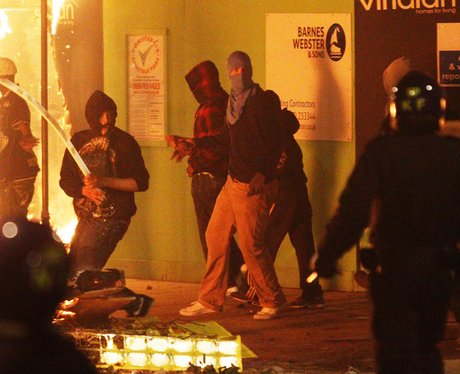
For the point about employment is that it gives the individual a sense of self-worth, of connecting to others as part of a larger structure. S/he has a personal investment in that structure, in other words is part of society. Where unemployment is systemic - not only have you never had a job, but neither have your parents or any of your friends - society is an ‘other’ and you have no other point of reference but your own real needs and the artificial ones created by consumerism. Why not smash a shop window and grab a flat-screen telly if you think you can get away with it?
Thatcher’s other key policy, privatisation, was a second major contributor to driving up unemployment. To give two examples from personal experience: as an LEA maintained FE College Section Leader in the early eighties I had 17 hours a week class-contact. When I regained the position in the late nineties, in the now independent corporation, this had risen to 21. The consequence of raising lecturers’ class-contact hours was that you needed fewer of them, thereby saving the College money. And what were those savings spent on: better facilities for the students? Were they, buggery: they were spent on hugely increased salaries for the Principal and the ‘Senior Management Team’.
The summer before we moved to Italy there was an eight hour daytime power cut in the Fens. The length of time it took to restore the electricity supply would have been understandable if it had occurred on a winter night when roads are treacherous and engineers are having to work in the dark in inhospitable conditions. But on a summer’s day? I rang Eastern Electricity to enquire whether the delay might be caused by the privatised company’s reducing the number of front-line staff in order to pay the inflated salaries and bonuses of the directors. The woman on the end of the line replied that she couldn’t comment, but the warmth in her voice suggested I’d hit the nail on the head.
Although it’s fairly obvious why we’ve landed in the current mess, it’s much more difficult to see how we get out of it. We can’t recreate our industrial base: those few ‘British’ manufacturers we have left - Jaguar, Range Rover, the Derby train manufacturer Bombardier - are foreign owned. The unemployed mob, only kept quiescent by free bread and circuses, was a perennial problem at the heart of the Roman Empire.And, alas, we all know what happened to that organisation, and the centuries of barbarism and savagery which followed its collapse.


Sunday, July 3, 2011

The Woodlanders meets The Wasteland


The Woodlanders was Hardy’s favourite child and it’s not difficult to see why.
I first came across it when I taught the novel as part of an undergraduate module on the Pastoral. When the module was scrapped as a consequence of the move from terms to semesters I’d become so fond of the text that I incorporated it into an Access to HE 19th Century Literature module. It suited the interdisciplinary nature of our Access course well. Through Grace Melbury Hardy dramatises the way so many of us today are torn between the familiar and the rooted, embodied in Giles Winterborne and the village of Little Hintock, and the pull of the new and provisional, given flesh in Fitzpiers. Prior to the 19th century the dilemma wouldn’t have existed for the overwhelming majority of people: you were stuck with your roots whether you wanted them or not. Although Hardy paints Giles as a far better man than Fitzpiers, and his heart is with the world of Little Hintock, he knows that what it represents has had its day. The future is Fitzpiers.
A couple of years ago I’d quite enjoyed reading Giro di vento a novel by the contemporary Italian author, Andrea De Carlo. Partly prompted by the falling off of Camilleri’s powers, I decided recently that I ought to get to grips with some serious contemporary fiction. So I sent off for a couple more books by De Carlo. I’ve just finished the first: Due di due. Unlike Giro di vento it didn’t immediately grab me: I found the first 100 pages tedious. And the title puzzled me: what did Due di due signify? I looked on Amazon to see what title an English translation might have, if one existed. It did: Two Out of Two, which didn’t help at all. Fortunately the answer to my question appeared on page 216. ‘Pensavo a quanto le nostre vite erano state diverse in questi anni, e anche simili in fondo, due di due [my italics] possibili percorsi iniziati dallo stesso bivio’ - I thought about how greatly our lives had diverged over the years and how at the same time they were fundamentally the same: although we’d each followed a different route, both of them were one of the two possible directions which began at the same crossroads.
As grammar school pupils growing up in Milan both Mario, the narrator, and his best friend Guido had been disenchanted by the values which the City embodied and its unhealthy physical environment: Milan’s smog is notorious. It is Eliot’s ‘Unreal city’. Guido’s solution is to pursue the infinite possibilities which the world offers, hating to be tied to one place because that necessarily excludes all the others. He has a similar attitude to women. As Martina, the monogamous narrator’s partner puts it:
‘… ogni donna era per Guido una chiave che gli permetteva di entrare in un’altra vita, sperimentarla nel suoi risvolti più intimi invece di immaginiarsela dal di fuori. … le donne gli piacevano come persone, e lui evidentemente piaceva a loro, ma doveva essere l’ossessione per le infinite possibilità parallele a rendere senza fine la sua ricerca’ - for Guido every woman was a key which allowed him to enter into another life, to try it out in its most intimate aspects rather than just imagining it from outside. … he liked women as individuals, and they obviously liked him, but he had to follow his obsession with the infinite parallel possibilities, which made his research endless..
In other words he kept moving from woman to woman!
Mario’s solution is to go for self-sufficiency in a remote spot of the Umbrian countryside, teaching himself - from books he buys in Perugia - how to start an organic smallholding . He and Martina, an assistant in the Perugian bookshop when he met her, have children together and slowly make a success of their business,

Like The Woodlanders, Due di due ends movingly. As a symbolic gesture, Mario commemorates his friend’s death by literally torching the adjacent house Guido should have occupied, but never did. Guido’s choosing a different but complementary path had illuminated the narrator’s life.
Unlike Hardy, De Carlo ultimately comes down on the side of ‘returning to the land’ as the way forward. A nice idea, but - despite its popularity with some idealists here - until we’re forced into it by the collapse of western civilisation it’s pretty unlikely to have many takers I’d say!

Tuesday, May 24, 2011

Another inconvenient truth.


As a small boy in the late ’forties and early ’fifties I was an ardent imperialist, spending hours in the lending library devouring Arthur Mee’s Our Empire Story. Unfortunately, although Empire Day was still marked at my primary school, the institution it celebrated was rapidly joining Nineveh and Tyre. One thing puzzled me: why had the French labelled our nation ‘Perfidious Albion’? For Arthur Mee made it clear that England had heroically shouldered the burden of bringing enlightenment to the savage regions of the world.
When I was a sixth-former I discovered the answer. Together with a group of classmates I attended a meeting of the Council for Education in World Citizenship held at a local girls’ day-school. The draw, of course, was the girls not any desire to become a world citizen. As a sex-starved teenager incarcerated in a boys’ boarding school any opportunity to be in the same room as a girl was eagerly seized. The main business of the meeting was a talk on the White Highlands given by an indigenous Kenyan. The speaker was a quietly spoken man who steered clear of passionate denunciations of injustice. His case was the more compelling for it. I left the meeting a changed man.
At university I became aware of aspects of Our Island Story other than those highlighted by Mee: strapping Indian mutineers across the muzzles of cannon and then firing them; going to war with China because their Emperor tried to curb his people’s addiction to opium. Opium grown very profitably in the jewel in our empire’s crown.
Although the Empire, along with my youth, is long gone its attitude to ‘lesser breeds’ persists. Today’s Guardian carried the unbearably moving story of a severely injured 13 year old Iraqi boy ‘lost’ by the Army medical corps. After visiting the hospital for ten days, without being allowed to see his son, his father was told that he was becoming ‘annoying’ and banned from making further visits. A year later he was told that the boy had been moved to Kuwait and the army had lost track of him. Unbelievably two and a half years later the army's chief claims officer said he could not offer any compensation for negligence “since I have been unable to find any such evidence of negligence by the British forces in this matter”. The letter ends: “Please accept my sincere sympathy”.
And there you have it: we’re a decent civilised people, able to offer sincere sympathy even to an annoying Iraqi who’s unaccountably upset that his son has disappeared and has the impudence to accuse us of negligence.

Sunday, May 22, 2011

Modern Times


The concluding sentence of an article by Katherine Whitehorn in today’s Observer puts its finger on the problem underlying the malaise affecting contemporary British society:
‘… what has actually been correct, politically in Britain from Mrs Thatcher to Tony Blair? Not an insistence on equality, just an insistence on the efficacy of profit and competition – not public service or honour or professionalism – to cure any failing or inefficiency in anything.’
Underlying this new political orthodoxy is the false belief that people are chiefly motivated by money. On the contrary, as Bertrand Russell put it:
‘Of the infinite desires of man, the chief are the desires for power and glory…When a moderate degree
of comfort is assured, both individuals and communities will pursue power rather than wealth : they may seek wealth as a means to power, or they may forgo an increase of wealth in order to secure an increase of power, but in the former case as in the latter their fundamental motive is not economic.’
Job-satisfaction has much more to do with an employee’s freedom to make his own decisions about the sensible way to carry out his role than with the size of his pay-packet. In other words, a degree of power over his own working life. And for most of us that’s enough. Some individuals, though, crave power over others which leads them to become - in the worst case scenarios - dictators, but in the majority of cases merely charge-hands, foremen, ward-sisters, managers, or chief executives. If Bob Diamond were given the choice of continuing in post at a tenth of his present salary or working as a counter-clerk with no loss of income (the option of transferring to another company being excluded ) can one doubt for a moment what his decision would be?
And yet our government is in thrall to the misconception that unless we pay senior executives silly sums of money no one would take the job, so leading to the situation that whilst the overwhelming majority of people’s incomes are falling in real terms those of the highest earners are increasing substantially.
It’s not only morally obscene, but utterly unnecessary.

Wednesday, April 13, 2011

Europe(an) matters


Read an interesting article in this month’s Red Pepper. It seemed to bear out what I’ve long suspected: behind their anti-European rhetoric British prime ministers, both Labour and Tory, know that European integration is essential if this country is to survive. Thatcher, seemingly the Daily Mail incarnate, signed up to the ERM, Major signed the Maastricht Treaty, and Brown the Lisbon Treaty.
Since Heath, there’s only been one overtly pro-European premier and he chickened out of joining the Euro, a policy in which he believed but was too frightened by Murdoch to carry out. Such a shame John Smith succumbed to a heart attack: according to Francis Beckett things might have been very different if he’d survived.
The Red Pepper article points out that the fact that ‘the EU has signed up for … centralisation under the aegis of Brussels of national budgetary decision making for all member states as of 2011’ has received very little coverage in the British tabloid press. Instead they rouse their readers to fury with stories of ‘how the EU allegedly wants to harmonise condom sizes, ban smoky bacon crisps because the woodsmoke seasoning may cause cancer, and rename chocolate “vegelate”.’
Red Pepper, like many on the left, deplores the way in which the inexorable growth in Brussel’s power is hidden from the public. So do I, but for rather different reasons. Unlike Red Pepper I think the EU is our future. But like Red Pepper, Ukip, the BNP and the Daily Mail I’m opposed to rule by ‘unelected bureaucrats’. And there’s a simple answer: give the real power to the European Parliament not the Commission. But that, of course, wouldn’t suit those running Westminster whether they’re Labour or Tory. Far better to continually carp about the EU to keep the Murdoch press and the Daily Mail onside whilst in reality supporting rule by unelected bureaucrats because it’s the national governments who put them in post.
There is an alternative vision: to rejoice in being European, to cherish that common culture, depicted in the map above, which gave us peace and prosperity for half a millennium. And to strive for the day when we once again have the political and economic union which might give us a chance of surviving in a world dominated by China, India and Brazil. As someone much more eloquent than I once put it:

“We British are as much heirs to the legacy of European culture as any other nation. Our links to the rest of Europe, the continent of Europe, have been the dominant factor in our history…Too often, the history of Europe is described as a series of interminable wars and quarrels. Yet from our perspective today surely what strikes us most is our common experience… It is the record of nearly two thousand years of British involvement in Europe, cooperation with Europe and contribution to Europe, contribution which today is as valid and as strong as ever…
Britain does not dream of some cosy, isolated existence on the fringes of the European Community. Our destiny is in Europe, as part of the Community.” [Margaret Thatcher, September 20th, 1988]

Thursday, March 3, 2011

… and darkness was upon the face of the deep


In the small hours of Tuesday morning a torrential downpour began which lasted until early evening. We read subsequently that it was the heaviest downpour Le Marche had experienced in 40 years: 18 cm in 24 hours. Not only did it produce a lake in the library, but it started coming down the kitchen chimney. When I took the dogs out last thing at night I found the rain had given way to deep snow. On Wednesday I woke up to find we were without electricity - judging from the Teasmade clock it had gone off at 12.35. We were eventually reconnected today at 3.40 in the afternoon, some 39 hours later.
As you can see from the picture we were not alone in our misery. And what misery it was. For starters the central heating and the hot water don’t function without the electric pump . The cordless phone wouldn’t work. And not only did the contents of the freezer thaw out but we realised how utterly dependent on electricity we are for our entertainment. Because the power had gone off at night when we charge up our iPhones they had very little juice left in them so they weren’t available to entertain us. There was no telly or radio and the candles didn’t really give enough light to read by. We’d eaten dinner early, for it needed to be prepared in daylight, and consequently had a vast expanse of evening with nothing to do. I did find a pack of cards and played patience for a bit but otherwise it was a dreary time. And we couldn’t just go to bed because I have to take the dogs out last thing at night. As a couple of Cambridge computer scientists have written, take down a country’s electricity supply and it ceases to function.
I guess with the decline of the West yesterday probably represents the future. Thank God I won’t be around to experience it for very long.

Tuesday, February 8, 2011

Smoke and mirrors


This morning, in the words of The Evening Standard, ‘George Osborne tightens squeeze on banks with £800m raid on profits’. In reality he's doing no such thing. As Robert Peston explained on the Today programme, £800 million is dwarfed by the sum the banks are paying out this year in bonuses: around five thousand million.
Unfortunately, Peston didn’t raise the issue of a very different tax change revealed by George Monbiot in today’s Guardian. This abolishes taxation on earnings from a bank’s overseas branches whilst at the same time allowing it to claim the expense of funding its foreign branches against tax it pays in the UK. Far from causing the banks pain, the Posh-Boys’ squeeze resembles one given by an aged roué to his mistress’s thigh as he empties his wallet into her lap.
But it will no doubt convince the readers of the Daily Mail that tough action is being taken. In Monbiot’s words:

‘… this government … has learned the lesson that
Thatcher never grasped. If you want to turn this country
into another Mexico, where the ruling elite wallows in
unimaginable, state-facilitated wealth while the rest can go
to hell, you don't declare war on society, you don't
lambast single mothers or refuse to apologise for Bloody
Sunday. You assuage, reassure, conciliate, emote. Then
you shaft us.’