Wednesday, February 1, 2012

Placating the plebs.

It's placate the plebs time for the posh-boys' government. First Stephen Hester was pressurised into foregoing his bonus of a little under a million pounds, and then Fred Goodwin was stripped of his knighthood. So all we ordinary folk can rest assured that although our nominal incomes may be frozen and our real incomes are shrinking we are all in it together. The Establishment is dealing firmly with the greedy or the dishonourable. Jeffrey Archer is no doubt penning a speech to the Lords celebrating the fact.

Hester now has to scrape by on his basic salary of £1.2 million. Thank heavens, as the This is Money website points out, Fred still has his taxpayer-funded pension of £342,500 a year to help him cope with his humiliation. 

Monday, January 23, 2012

A mess of pottage.

An article by Jeremy Paxman in today's Guardian articulates the view I've long held that the West is heading for disaster.  We arrogantly assume that it makes economic sense to outsource manufacturing to the Far East, deluding ourselves that we are the only ones with the brains to invent the innovatory products which are made there. In Paxman's words 'western welfare states .... have sold their future for the sake of cheaper televisions and trainers'. To put it another way: Cecil Rhodes said that to be born British was to have won first prize in the lottery of life  - and we have sold that prize for a mess of pottage. 
   Is it possible to retrieve the situation? At a dinner last February President Obama asked the late Steve Jobs what it would take to make iPhones in the US rather than China. 'Why can't that work come home?' Apple's former chief laconically replied, 'Those jobs aren't coming back'. An article in last Saturday's New York Times explains why.  It's not simply that labour costs are lower but that the vast size of the Chinese workforce permits much greater flexibility than is found in the US. Unlike Britain, many of our fellow states in the EU still have healthy manufacturing industries. Although only around a third of the size of China's, the EU's population of five hundred million is large enough to create a manufacturing giant. To do so, of course, assumes that Euroland's woes can be overcome - and the only way to do so is by much tighter fiscal union, accompanied by a democratically accountable political union. Decent pay and working conditions would mean that the price of goods manufactured here would still be undercut by those from the Far East so there would have to be import controls. A small price to pay for an assured future, I'd say.
  Unfortunately the economic crisis is strengthening the appeal to the ill-informed of the xenophobic and fissiparous agendas pushed by idiots like the potty-mouthed Bossi, Marine Le Pen, and the Tory back bench.
  Welcome to The Return of the Dark Ages shortly to appear at a country near you.

Tuesday, January 17, 2012

The politics of shipwreck.


On Sunday, as part of its extensive coverage of the Costa Concordia foundering off the coast of Giglio, the Corriere della Sera published photographs of other ships which had come to a sticky end. The pictures were accompanied by brief statistics. I had always assumed that the number of lives lost in the Titanic disaster -1,523 - was by far the greatest to befall a passenger liner in the twentieth century. I was wrong. The Lusitania is the other liner whose disastrous end most people are aware of - 1200 lives lost thanks to a torpedo launched by a German submarine. Although the Titanic holds first place in public consciousness as the most tragic of maritime disasters one may well feel that the Lusitania's fate is even sadder. Its passengers' lives were lost not through human error but through human wickedness - the deliberate destruction of a defenceless passenger ship by the beastly Germans.
 Yet the Lusitania was not the only unarmed ship deliberately destroyed by an enemy submarine. On  the 30th January 1945 nine thousand people lost their lives when their ship was torpedoed in the freezing seas of the Baltic. Until I read about it in the Corriere this disaster had completely passed me by. And I wonder why: six times as many people perished as those who died in the Titanic. Part of the answer of course is that the Wilhelm Gustloff was a German ship which, in the words of the Corriere, was 'evacuando personale nazista in fuga' - evacuating fleeing nazi personnel -  though in fact many of them were civilians. I think the real reason for the Wilhelm Gustloff  being consigned to the scrapyard of history is not so much that some of its passengers were nazis but that the Americans weren't involved. Although the Titanic and Lusitania being British explains why we remember their fate, the truly significant fact is where they sailed to rather than where they sailed from. American culture dominates the world, so America's tragedies are projected by Hollywood to fill a global screen leaving those of other nations in the outer darkness of oblivion.


Tuesday, January 10, 2012

Not so full of beans.


Time is a concept whose outward and visible sign is change: without change there would be no time.  And on one level we twenty-first century folk are very conscious of its passing  with our calendars, our clocks and watches accurate to a nano-second thanks to their quartz crystals or radio signals from an atomic clock, and our New Year's Eve celebrations and tedious media retrospectives.
   The truly important changes, though, creep by without our really being aware of them. Without a mirror, I'd probably think that my outward appearance conformed to my inner image which hasn't been updated for some forty years. In my late twenties I shaved off the beard which I'd sported since leaving school and was deeply shocked by what I saw: a fresh-faced eighteen year old replaced by someone verging on thirty - the year at which I then believed senility began. The subtle signs of ageing had been hidden by the face fungus; I started regrowing my beard the following day. And even without the benefit of a beard our families and friends seem to be unchanging - when we see someone frequently the slight physical difference from the last time we saw them is undetectable.  Furthermore, our obliviousness of time extends to those we once knew well though many years have passed since the last time we  saw them: once the initial shock has worn off, the rupture in the space time-continuum repairs itself and the outward change no longer foregrounds itself.  Which brings me on to beans.
  When I was a schoolboy I was literally full of beans. Three times a week the school authorities allowed us to have our own food  cooked in the school kitchens - provided it was an egg or came in a tin. You sent your tin or egg, with the initial of your House and your boarder's number written on it, down to the kitchens where it would be boiled and then sent up by dumb-waiter to Hall at tea-time. I  sent beans. Beans in tomato sauce, curried beans, beans with sausages or, most often, the 'Family-Size' tin - but always beans, my passion  for them was boundless. 
   Strangely, baked beans do not form part of the Italians' diet although you can buy Heinz beans, at enormous expense, hidden away in the ethnic section of hypermarkets. Fortunately, they're also obtainable at a more affordable price from the Lidl stores on the coast which have sprung up to cater for the needs of the financially-challenged. A week before Christmas we went to the shopping mall in Civitanova Marche to buy our elder daughter's Christmas present and when we were coming out my wife asked me if I wanted to go on to Lidl's to stock up with beans. To my own astonishment I declined, and as I did so I realised Time was doing its stuff: my taste buds had changed. Since moving to Italy I have gradually lost my liking for filter coffee - I now find it unpleasantly insipid. For the first few years I cooked a roast dinner every Sunday: now it's a rare event whose resulting  mix of heterogeneous ingredients heaped on the same plate seems vaguely odd. I still look forward to fish and chips when I visit the UK, but almost invariably find they disappoint. English ex-pats rave about cheddar cheese and bemoan its unavailability here. I no longer know why - a decent cheddar is worth eating, but the stuff sold by a recently opened English Shop in a nearby town struck me as unpleasantly cloying with the texture of savoury fudge.
  So just as I have become gradually harder and harder of hearing, but only recently become aware of it, in a similar way my tastebuds have surreptitiously become Italianised by some mysterious process of osmosis. If only the same process operated with what came out of my mouth as opposed to what went in it, I'd be a happy man.

Monday, December 5, 2011

S is for Subjugation.


I suppose I've been aware of the gradual Americanisation of English, as spoken in the UK, for around half a century. I think 'radio' replaced 'wireless' in my late teens',  it cannot have been much earlier. An OE writing in the 1955 edition of the school magazine commented as follows on the differences between Canadian and British English: 'I found that some care was required in speaking the language … such ordinary alternatives as wireless and radio, lift and elevator … are easily learned …' 'Train station' for 'railway station' is more recent and its usage at first was confined to the less-educated sections of society. Today it's virtually universal.
   The North American influence has also affected the way most people pronounce our language: stressing the first syllable of 'research' rather the second, and the second of 'lamentable' rather than the first; pronouncing 'covert' to rhyme with 'overt' in defiance of the word's meaning, though I don't think anyone's yet started to mis-pronounce 'covert coat'. The other day I heard someone on Radio Four pronounce the first syllable of 'patent' as a homophone of my wife's christian name. No doubt in five year's time it'll be the norm.
  The latest insidious change is the addition of the American 's' to words indicating categories: sport has become sports, bread breads, fruit fruits, and meat meats. Again, the change has spread rapidly from the lexically challenged to the educated classes: I caught Simon Hoggart using it in the Guardian a few days ago.
  'So what?' you may ask. Language is in a continual state of flux, always has been, always will be. But this, I would argue is different: it is not about the adoption of words from a foreign language or a shift in meaning of a particular word. Rather it is the displacement of one language by another. And languages differ from one another not simply in their vocabulary but in the way they structure experience. To give a couple of simple examples: an Englishman will say, 'I miss you', an Italian 'Mi manchi' - literally 'You are missing to me'. An Englishman will say, 'He waited until the rain stopped', an Italian 'ha aspettato finché non ha smesso di piovere - literally 'he waited as long as it had not stopped raining'.
   American English in speaking of 'fruits', 'meats', 'breads' etc emphasises the differences between the items in a category, traditional British English what they have in common. The former is an expression of individualism, the latter of civilisation. Although it is fashionable in this politically correct age to refer to the 'civilisation' of nomadic peoples such as the Australian aborigine or the native American the word is being misused. Rather, they have cultures, in many cases worthy of respect. Civilisation refers to a complex culture organised around the cives or inhabitants of a city. It functions through the interdependence of the individual and the common good. The shoemaker makes his living by selling shoes to the farmer who raises beasts whose hides are sold to the tanner who sells his leather to the shoemaker who sells his shoes to the haulier who  transports the beasts from the farm to the tannery.
   Whilst America is a continent of cities, its self-image is the frontiersman, dependent on nothing but his own resources and a Winchester rifle. In the US anything which smacks of collectivism is rejected by large numbers of those who in fact would be its beneficiaries: Obama's health reforms were demonised as 'socialistic'. Unfortunately this myopic rejection of state power has been fervently adopted on this side of the Atlantic too: the NHS is gradually being reshaped into a 'facilitator' of private provision; coherent educational provision by LEAs is being fragmented by the promotion of 'independent' Academies and 'free' schools; and any attempt to protect ordinary people's living standards through collective bargaining vilified.
  And so the people of this once proud country wheel their trollies down the supermarket aisles shopping for breads, meats and fruits before going home to watch sports on television and dream of winning the lottery or an audition for The X-Factor. All the time vowing to resist the unelected bureaucrats from Brussels, and preserve their country's mythical independence. In reality they're simply unenfranchised Americans.

Sunday, December 4, 2011

Soixante-neuf for Italy.


How appropriate that Italy should be ranked sixty-ninth in Transparency International's  league table  - showing it to be more corrupt than Ruanda -  given its politicians' weakness for awarding contracts in return for sexual favours. Or simply enjoying them without paying anything at all! New Zealand took first place for transparency, the UK was fourteenth.


Thursday, August 11, 2011

Thatcher's children.


The Prophetess Thatcher - a curse be upon her - famously remarked ‘There is no such thing as society’. And by abolishing capital controls the year she came to office she ensured her vision came to pass.
The consequence of the lifting of controls on the export of capital was the de-industrialisation of Britain. Manufacturing was transferred overseas to take advantage of cheap labour. With two results: a boost to consumerism as the cost of manufactured goods came down, and a systemic rise in unemployment. As Harold Macmillan commented in 1985: ‘Sixty-three years ago... the unemployment figure] in Stockton-on-Tees] was then 29%. Last November... the unemployment [there] is 28%. A rather sad end to one's life.’
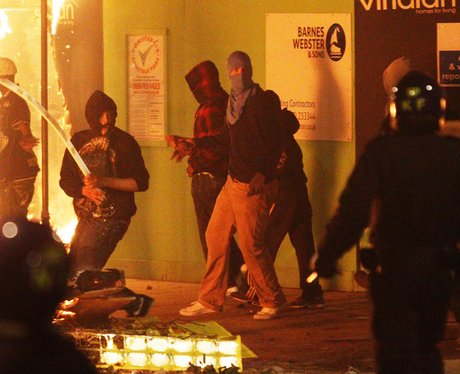
For the point about employment is that it gives the individual a sense of self-worth, of connecting to others as part of a larger structure. S/he has a personal investment in that structure, in other words is part of society. Where unemployment is systemic - not only have you never had a job, but neither have your parents or any of your friends - society is an ‘other’ and you have no other point of reference but your own real needs and the artificial ones created by consumerism. Why not smash a shop window and grab a flat-screen telly if you think you can get away with it?
Thatcher’s other key policy, privatisation, was a second major contributor to driving up unemployment. To give two examples from personal experience: as an LEA maintained FE College Section Leader in the early eighties I had 17 hours a week class-contact. When I regained the position in the late nineties, in the now independent corporation, this had risen to 21. The consequence of raising lecturers’ class-contact hours was that you needed fewer of them, thereby saving the College money. And what were those savings spent on: better facilities for the students? Were they, buggery: they were spent on hugely increased salaries for the Principal and the ‘Senior Management Team’.
The summer before we moved to Italy there was an eight hour daytime power cut in the Fens. The length of time it took to restore the electricity supply would have been understandable if it had occurred on a winter night when roads are treacherous and engineers are having to work in the dark in inhospitable conditions. But on a summer’s day? I rang Eastern Electricity to enquire whether the delay might be caused by the privatised company’s reducing the number of front-line staff in order to pay the inflated salaries and bonuses of the directors. The woman on the end of the line replied that she couldn’t comment, but the warmth in her voice suggested I’d hit the nail on the head.
Although it’s fairly obvious why we’ve landed in the current mess, it’s much more difficult to see how we get out of it. We can’t recreate our industrial base: those few ‘British’ manufacturers we have left - Jaguar, Range Rover, the Derby train manufacturer Bombardier - are foreign owned. The unemployed mob, only kept quiescent by free bread and circuses, was a perennial problem at the heart of the Roman Empire.And, alas, we all know what happened to that organisation, and the centuries of barbarism and savagery which followed its collapse.